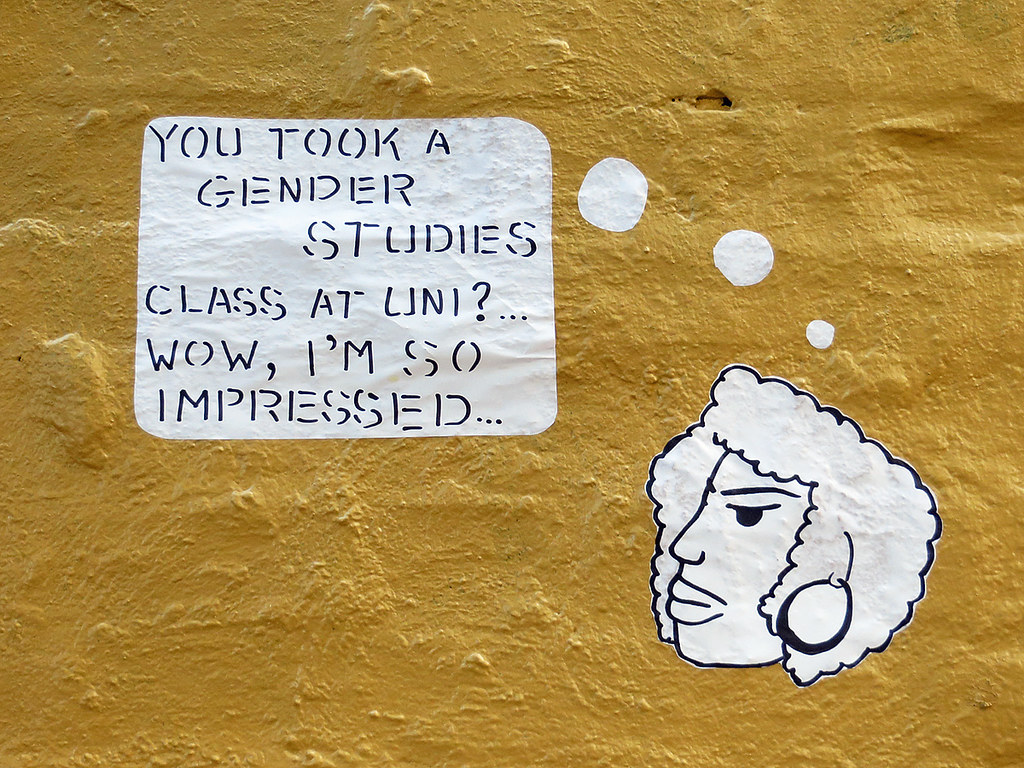
At JKU, completing at least one semester of Gender Studies is a mandatory requirement for graduation. Unfortunately, this is not the case at many universities—either within or outside Austria. In our opinion, this should be the case. I’ll explain why.
In terms of law and theory, everyone has equal rights. About 200 years ago, this was certainly not the situation. Women were viewed as the property of men and had hardly any rights. A great deal has changed since then. Women have been allowed to vote in National Council elections since 1918. It was not until 1975 that women were permitted to work and open a bank account without a man’s permission (such as that of a father or husband); prior to that, they were entirely dependent on men. Since 1989, marital rape has been a criminal offense, with penalties no longer contingent on the victim’s behavior. Abortion remains a matter of criminal law.
These legal changes are all relatively recent, and unfortunately, societal change is progressing even more slowly. The notion that FLINTA* individuals are of lesser value and should be treated differently remains palpable everywhere. Patriarchal structures are still deeply rooted in our society. Rigid gender roles often persist within heterosexual relationships; cisgender men frequently earn more than FLINTA* individuals for the same work and enjoy greater representation and prestige in politics; there are still associations that exclude FLINTA* individuals; and FLINTA* people face a higher risk of being raped or even murdered—whether on the street or within relationships.
Gender Studies analyzes this history and scientifically investigates the actual nature of the differences between genders. The field examines all aspects of life—work, education, family, culture, religion, and media. Where do inequalities exist, where do they originate, and how can they be resolved? Many misconceptions—circulated in the past and still prevalent today—are being debunked.
Education can make a huge difference when properly addressing these inequalities. Gender studies demonstrates, through scientific evidence, that the differences between the sexes are not nearly as vast as society leads us to believe. The differences are really a social construct rather than „natural,“ and numerous ideas regarding gender and gender roles in our society lack a factual basis. Exposing students to these insights prompts conscious or unconscious reflection; as more people contemplate these issues and adjust their behavior accordingly, inequality and discrimination will diminish.
It is particularly beneficial for students who do not otherwise encounter feminist ideas or texts within their degree programs or personal lives to be exposed to these concepts. By raising broad societal awareness regarding the persistence of unfounded discrimination and inequality, we can accelerate social change and build a better world. For this reason, we welcome the fact that gender studies is a mandatory subject at the JKU, and we believe this model should be adopted by other universities as well.
FLINTA* is an acronym often used in German. It stands for Female, Lesbian, Intersex, Non-binary, Trans, and Agender people and represents people oppressed by the patriarchy.